
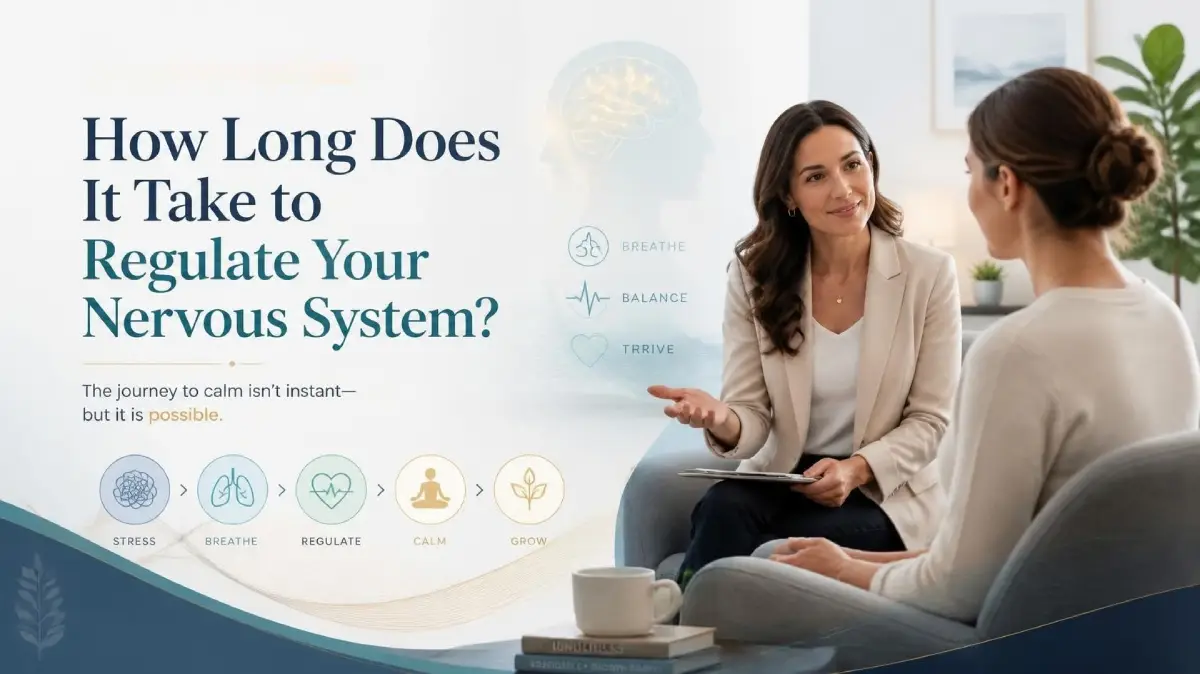
The first thing worth knowing about nervous system regulation is that it rarely happens in one big moment. It is usually quieter than that. A person may notice that sleep feels a little deeper. A stressful message does not ruin the whole afternoon. The shoulders drop without being told. These small changes can show up before life feels completely calm.
At Inner work with pranav, nervous system work is often easier to understand when it is treated as a process rather than a finish line. The body has learned its patterns over time. It may take time to learn a different pattern too.
How long does it take to regulate your nervous system?
For some people, small changes can be noticed within days or a few weeks. More lasting regulation can take several weeks or months. There is no honest number that fits everyone.
A rough picture looks like this:
- A few days to 2 weeks: breathing may feel easier and the body may notice moments of calm.
- 2 to 6 weeks: sleep, tension and recovery after stress may begin to improve.
- 1 to 3 months: reactions may feel less intense and it can become easier to return to calm.
- Several months or longer: deeper patterns can shift, especially when stress has been present for years.
These are not deadlines. They are simply useful ranges. A person dealing with a short stressful period may recover much faster than someone who has lived with constant pressure for a long time.
One thing that often gets missed is the difference between feeling calm and being able to recover from stress. A regulated nervous system does not mean never feeling angry, nervous or upset. It means the body can move into stress when needed and then find its way back.
A simple example makes this clearer. Imagine getting an unexpected work message at 9 pm. The heart jumps. The mind starts racing. The person puts the phone down, takes a few slower breaths, sleeps and wakes without carrying the whole event into the next day. That return matters.
Why does nervous system regulation take so long?
The nervous system responds to repetition. If the body has spent months or years expecting pressure, it may not trust calm straight away. Sitting quietly for ten minutes can feel strange. Sometimes it can even feel uncomfortable.
This is why pushing harder does not always help. Someone may spend an hour trying to force relaxation and end up checking whether relaxation is happening every thirty seconds.
Daily life also matters. Poor sleep, long work hours, constant phone use, conflict, loneliness and little movement can keep the body on alert. One calming practice cannot always cancel all of that.
There is also the issue of personal history. A person who has experienced repeated stress may have stronger automatic reactions. It simply means the body has become very good at protecting itself.
With Inner work with pranav, a gentler view can be useful here. Regulation is less about controlling every body sensation and more about giving the system enough safe and steady experiences that calm becomes familiar.
What are the signs that your nervous system is regulating?
The signs are often surprisingly ordinary. They may not feel like a dramatic healing moment. In fact, they can be so small that they are easy to ignore.
Common signs include:
- Breathing becomes slower without much effort.
- Sleep starts to feel more settled.
- The jaw and shoulders stay less tense.
- Small problems do not feel like emergencies.
- It becomes easier to pause before replying.
- After a stressful event, recovery happens sooner.
- Hunger and tiredness become easier to notice.
- There are longer stretches of feeling present instead of constantly switched on.
Another useful sign is flexibility. A person may still have a bad morning but recover by lunch. There may still be worry before an important meeting, but the worry does not control the whole day.
This is where progress can be missed. People often look for a permanent peaceful feeling. That is not really how the nervous system works. The goal is not to stay calm forever. The goal is to have more choice and a quicker return to balance.
What helps regulate the nervous system faster?
There is no magic shortcut, although the internet can make it sound that way.
A steady sleep schedule can help. Regular movement helps the body use some of the energy created by stress. Slow breathing can be useful for some people. Time outside, quiet breaks and supportive relationships matter too. Eating regularly can also help when long gaps between meals leave someone shaky and irritable.
A simple daily rhythm might look like this:
Practice | Simple starting point | What to notice |
Slow breathing | 3 to 5 minutes | Easier exhale |
Walking | 15 to 30 minutes | Less restless energy |
Sleep routine | Similar bedtime | Easier settling |
Quiet time | 5 to 10 minutes | More awareness of tension |
Social connection | A short honest conversation | Feeling less alone |
The important part is repetition. Five minutes done most days can be more useful than one long session done once and forgotten.
It is also worth saying that breathing should never become a competition. Bigger breaths are not always better. If a technique causes dizziness, panic or discomfort, it is sensible to stop and return to normal breathing.
Can you regulate your nervous system in 30 days?
Thirty days can be enough to notice meaningful changes, but it is not a guaranteed reset. A month gives the body repeated chances to practice a different response.
For example, someone might spend the first week simply noticing when tension appears. The second week may add a few minutes of slower breathing. The third week may focus on sleep and less late-night scrolling. The fourth week can be about keeping what actually helped.
The result may not be dramatic. Maybe falling asleep takes 20 minutes instead of an hour. Maybe an argument stops being replayed all night. Maybe the body feels tired after a busy day instead of wired and unable to settle.
Trying to measure progress every day can actually make the process harder. The nervous system is not a fitness tracker. There will be good days and odd days. A rough night does not erase a month of progress.
A useful way to track change is to compare weeks rather than individual days.
Area | Earlier pattern | Possible change over time |
Stress | Takes over the whole evening | Settles after some time |
Sleep | Mind stays busy in bed | Easier to switch off |
Body tension | Jaw or shoulders stay tight | Tension comes and goes |
Emotions | Quick strong reactions | More pause before reacting |
Recovery | Takes a day or more | Returns to normal sooner |
What if the nervous system does not seem to calm down?
Sometimes the usual self-care steps are not enough. Ongoing fear, panic, severe sleep problems, trauma symptoms or physical symptoms deserve proper support. Nervous system language can be helpful, but it should not be used to explain every health problem.
A doctor or qualified mental health professional can help when symptoms are intense, persistent or getting worse. There is no prize for handling everything alone.
It can also help to drop the idea that the body must be perfectly regulated. Humans are built to respond to change. A nervous system that reacts is doing its job.
The more realistic aim is resilience. Stress arrives. The body responds. Then, with practice and enough safety, it finds the way back.
That process may take weeks for one person and many months for another. Sometimes progress feels fast. Sometimes it seems to disappear for a while. That does not automatically mean nothing is happening.
At Inner work with pranav, the most useful perspective is a patient one. Notice the small changes. Give the body repetition. Do not turn every calming exercise into a test.
A nervous system does not need to be forced into peace. It needs enough steady experiences to learn that peace is possible.